The Customer
The customers are manufacturers and operators of pumps used in a wide range of industrial applications.
Initial Situation
Pump operation is often associated with recurring challenges: unplanned downtime occurs, and the underlying causes can only be conclusively identified afterward, often following time-consuming disassembly. Typical damage patterns range from impeller erosion caused by cavitation to asymmetric bearing wear resulting from misalignment. Both phenomena develop gradually and often remain undetected by conventional vibration sensors until shortly before failure.
Objectives
Together with the customer, the following operating conditions were identified for continuous monitoring:
- Cavitation detection: Early detection of pressure impulses and shock loads caused by vapor bubble collapse in the impeller, which directly stress the bearings.
- Misalignment detection: Identification of axial and radial force asymmetries indicating incorrect shaft alignment or uneven wear.
- Extended bearing life: Protection of rolling-element bearings through timely corrective action before fatigue damage becomes irreversible.
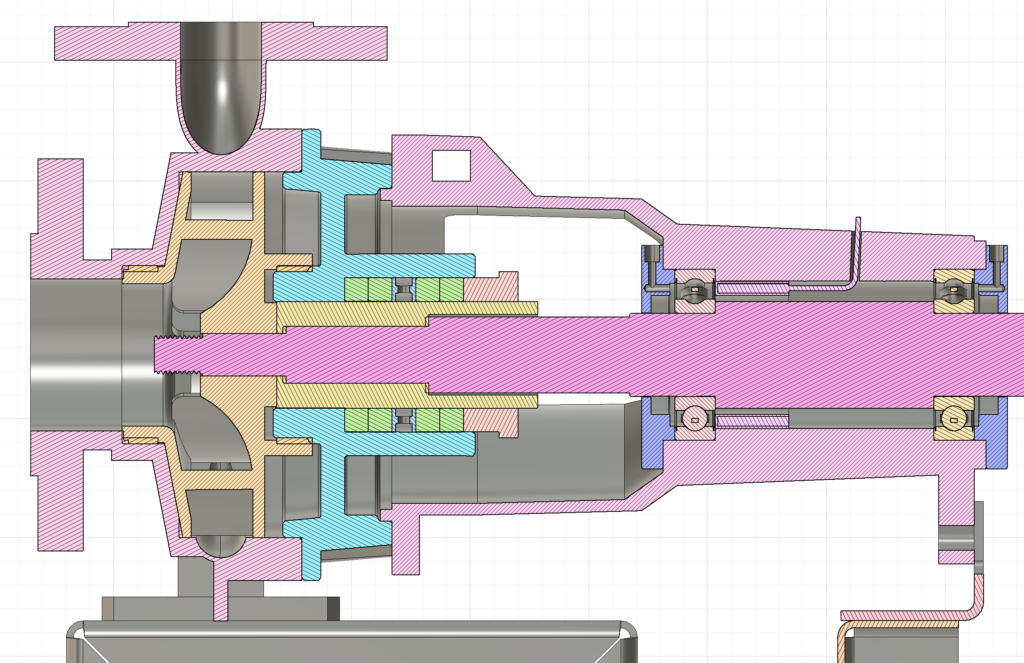
Solution: Integrating the HCP Sense Sensor Ring Between the Bearings
HCP Sense developed a compact sensor ring that was integrated into the pump housing in the limited space between the drive-side and pump-side rolling-element bearings. Based on electrical impedance measurement, the ring continuously monitors the lubricant film condition and the mechanical loads acting directly on the bearing locations.
The integration required no modifications to the existing shaft or housing geometry. The sensor ring was fitted into the available space between the two bearings and connected to HCP Sense evaluation electronics. Commissioning took place directly at the customer’s site and was completed within half a day.
The measurement system captures:
- Changes in the electrical impedance of the lubricant film in both bearings, providing a direct indication of hydrodynamic lubrication conditions.
- Shock impulses and frequency patterns characteristic of cavitation events.
- Asymmetries in the load distribution between the bearings as an indicator of misalignment.
Results
The system delivered clear, reproducible measurement signals during the very first phase of operation.
Cavitation
Even with a slight deviation from the design operating point under partial-load conditions, the sensor ring detected characteristic shock patterns correlated with the onset of cavitation — well before any corresponding acoustic or vibration effects became perceptible. The operator was able to adjust the operating point and virtually eliminate cavitation.
Misalignment
An existing, previously undetected misalignment of approximately 0.15 mm manifested itself as a persistent asymmetry in the bearing loads. Only after the alignment was corrected did the measurement values on both bearing sides return to a balanced level. This condition would not have been detectable using a single vibration sensor mounted externally.
Extended Bearing Life
By combining an optimized operating point with corrected shaft alignment, the calculated bearing service life could be more than doubled. Since then, the system has continuously monitored bearing and lubrication conditions, verifying that the improved operating conditions are maintained. Any deviations are reported as soon as they occur.
In addition, demand-based lubrication guided by the measured lubricant film values further extended bearing life.
The importance of detecting lubrication problems at an early stage is also demonstrated by another field test with Hitachi Energy. During a benchmark test, HCP Sense detected an emerging lubrication problem three weeks before the subsequent bearing failure.
Benefits for the Customer
- First-time visibility of cavitation and misalignment during operation, without disassembly or external test rigs.
- Early warnings at the physical source of the problem — before damage actually occurs.
- Significantly extended bearing service life through data-driven operating optimization.
- Minimal integration effort thanks to the compact sensor ring, which requires no modifications to the shaft geometry.
- A foundation for predictive maintenance, helping to prevent unplanned downtime over the long term.
Conclusion
The use of the HCP Sense sensor ring between the bearings clearly demonstrates the additional insight that can be gained by measuring directly at the point where the physical processes occur.
Cavitation and misalignment — two of the most common yet difficult-to-detect causes of damage in pump applications — can be reliably identified before they lead to bearing failure.
If you wait until vibration becomes audible, you are measuring too late. HCP Sense measures where the damage originates: directly at the bearings.