About EWD – Esterer WD GmbH
EWD – Esterer WD GmbH, with locations in Altötting and Reutlingen, Germany, is one of the world’s leading manufacturers of sawmill systems. With more than 150 years of experience in mechanical engineering and the design of industrial sawmill equipment, EWD combines extensive technical expertise with a commitment to the highest standards of precision and reliability.
Its product portfolio includes profile chippers, band saws, circular saws and profiling units, as well as the associated conveying and material handling technology – all from a single source.
With an export ratio of more than 80%, EWD supplies sawmills worldwide. Its machines often operate in multi-shift environments under extreme mechanical loads, where downtime is simply not an option. Accordingly, the requirements for availability, maintainability and component service life are exceptionally high.
Initial Situation
In industrial sawmills, the bearings supporting tool shafts and feed units are among the most heavily stressed components. High rotational speeds, impact loads caused by timber processing and the ever-present wood dust expose rolling bearings to extreme operating conditions.
Until now, relubrication was primarily based on fixed time intervals, regardless of the actual condition of the lubricant. In practice, this resulted in two opposing problems:
- Insufficient lubrication: Errors in manual lubrication or failures in automatic lubrication systems can cause excessive stress on the bearings, resulting in premature bearing damage.
- Overlubrication: During periods of lower operating loads, too much fresh grease was supplied. This led to excessive temperatures, increased grease consumption and unnecessary maintenance work.
EWD was therefore looking for a solution addressing two key objectives. First, it needed to provide insights into the actual loads occurring during operation, allowing improvements to machine design and machining processes. Second, it needed to reveal the lubrication condition inside the bearing to optimize relubrication intervals and prevent premature failures.
To achieve this, the bearing condition had to be monitored continuously and directly inside the bearing, with relubrication triggered only when actually required.
Project Objectives
The joint project focused on the following objectives:
- Operational load analysis: Gain insights into the actual loads occurring during operation to optimize machine design and machining processes.
- Condition-based relubrication: Trigger relubrication based on the measured lubricant condition rather than fixed time intervals.
- Preventing overlubrication: Avoid excessive grease supply, which can cause heat build-up, seal damage and unnecessary lubricant consumption.
- Extending bearing service life: Significantly increase bearing operating life through optimal lubrication conditions and prevent unplanned downtime.
The Solution: Monitoring with HCP Sense
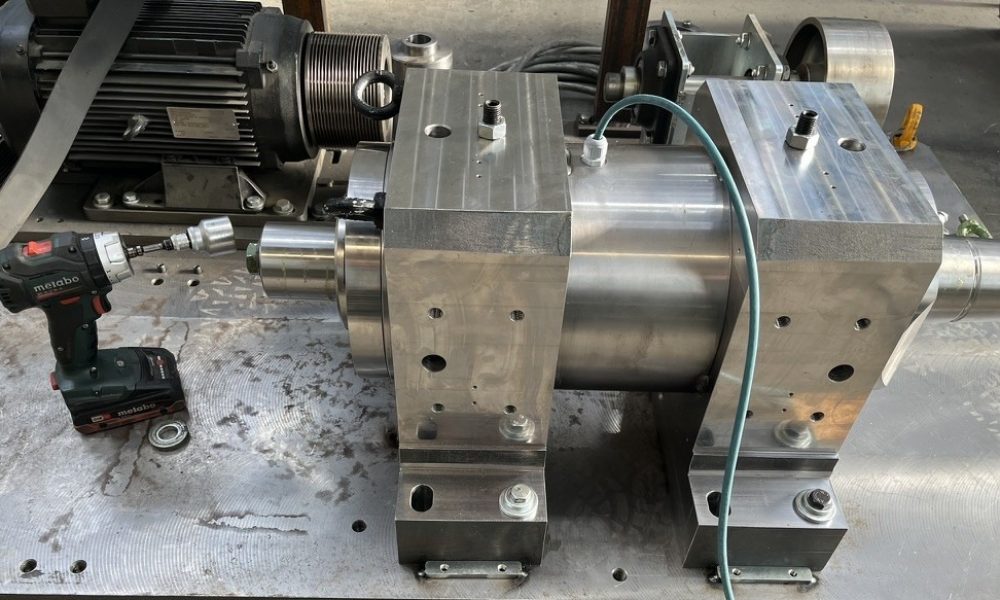
HCP Sense equipped the bearing arrangement of a new EWD profiling unit with its sensor system.
Impedance measurement takes place directly at the bearing rings, providing a precise, real-time picture of the current lubricant condition – including contamination levels caused by solid particles such as wood dust.
The sensor technology was integrated into the existing bearing arrangement without requiring major modifications to the shaft or housing.
As soon as the lubricant condition falls below a predefined threshold, the system sends a signal to the centralized lubrication system. The amount of grease supplied is then adjusted according to the measured condition rather than following a fixed time schedule.
Results
Detection of Wood Dust Contamination
Even at low particle concentrations, the system detected measurable changes in the lubricant’s impedance. These changes were identified significantly earlier than would have been possible through temperature monitoring alone, which typically only indicates an already developing bearing problem. The measured values correlated directly with the introduced contamination levels, confirming the reliability of the method.
Demand-Based Relubrication
By switching to condition-based relubrication, grease consumption can be reduced compared to the previous time-controlled system.
Prevention of Overlubrication
During periods of lower operating loads, relubrication was not triggered when it would previously have occurred automatically according to the fixed lubrication schedule. This helps prevent temperature peaks caused by excessive grease supply.
Benefits for EWD and Sawmill Operators
- Real-time visibility of lubricant condition directly inside the bearing for the first time.
- Reduced lubricant consumption by avoiding unnecessary relubrication.
- Protection against premature bearing failures caused by overlubrication, excessive loads or seal damage.
- Seamless integration into the existing EWD machine control system via a digital interface.
Conclusion
The collaboration with EWD demonstrates how essential demand-based lubrication is for reliable machine operation, helping to prevent both insufficient lubrication and overlubrication.
HCP Sense makes actual lubrication requirements visible before damage occurs. By combining direct measurements inside the bearing with automatic relubrication control, a reactive maintenance measure becomes an active protection function – delivering measurable benefits in terms of machine availability, component service life and operating costs.