Development Tool for E-Drivetrain Development
Our point of contact is the e-mobility development team, where a key challenge is understanding the condition of bearings and lubricants in relation to induced bearing currents in the e-drivetrain. By gaining a better understanding of these interdependencies, friction can be reduced, vehicle range increased, and the service life of mechanical components extended.
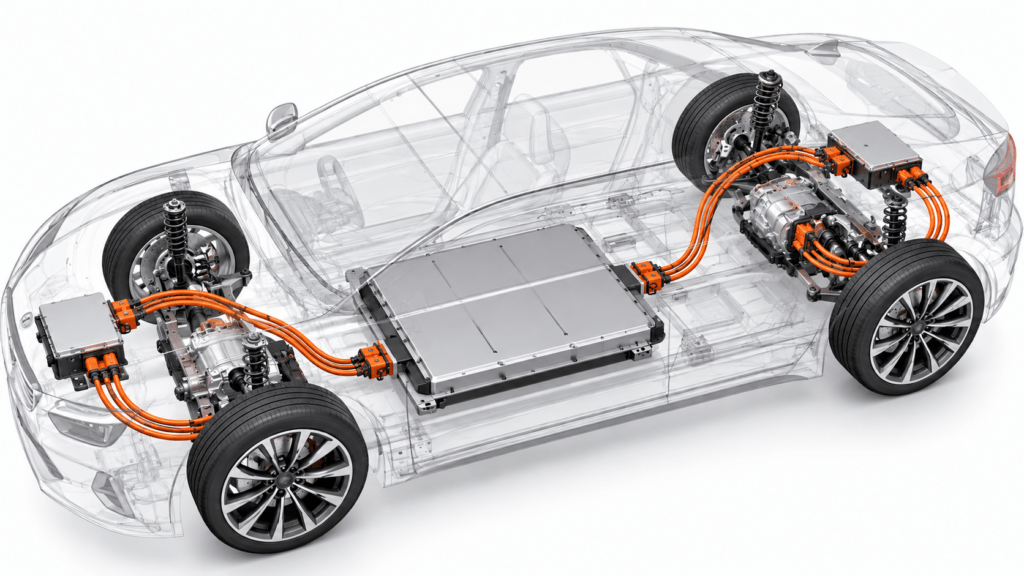
The Customer
Our customers are OEMs and Tier 1 suppliers in the automotive industry.
Objective
Induced currents in e-drivetrains are one of the key challenges associated with vehicle electrification. This gives rise to several objectives:
- Determination of bearing and lubricant condition: Electrical loads can cause damage to bearings and lubricants. Until now, these conditions could generally only be determined after testing by disassembling the components. The objective is to measure these parameters directly during testing.
- Determination of bearing electrical impedance: Bearing impedance is an important design parameter for the electrical design of the drivetrain and the resulting electrical loads. This parameter is measured directly during testing.
- Determination of bearing currents: Bearing currents are a critical indicator of the electrical load on bearings. These currents are measured during testing.
Implementation
Based on the drivetrain’s CAD model, HCP Sense proposes an integration concept for the sensor technology, which is discussed and optimized together with the customer. HCP Sense manufactures the sensor system, while the customer implements the necessary modifications to the drivetrain to enable the measurement campaign.
Commissioning is carried out jointly on site at the customer’s facility. After the sensors have been installed, initial tests are conducted together, enabling the customer to perform subsequent measurements independently without HCP Sense on site. HCP Sense then evaluates the test data, and the results are jointly reviewed and discussed with the customer.
Results
By measuring the electrical impedance, the customer’s calculation models could be validated. In combination with the current measurements, the actual electrical load on the bearings could be determined. This contributed to optimizing the electrical design of the drivetrain, while the influence of countermeasures could be quantified.
In addition, lifetime testing enabled the progression of bearing and lubricant degradation to be monitored and quantified.