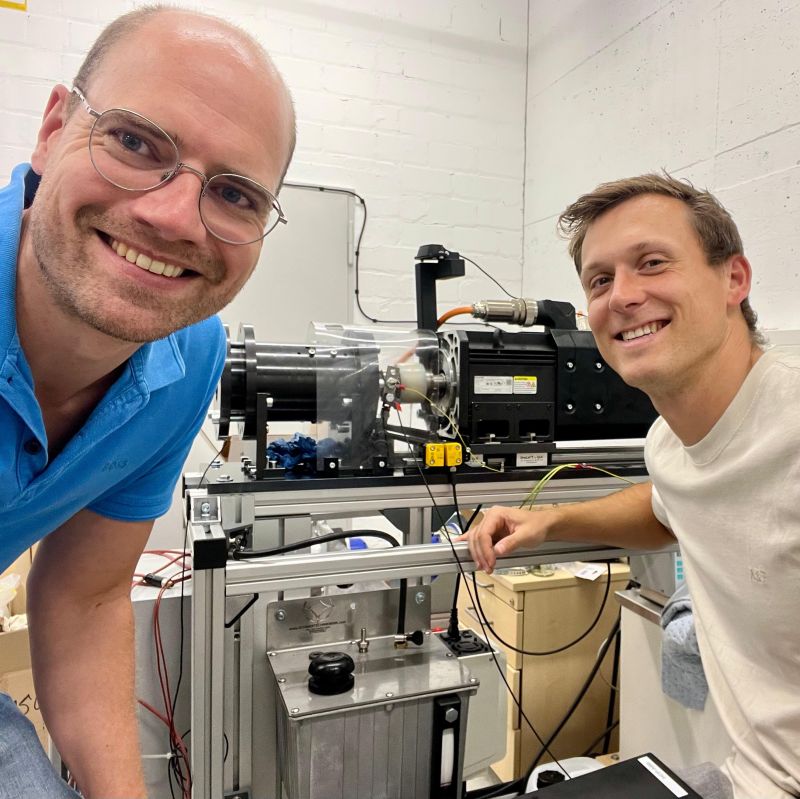
What the garage is to other startups, our basement laboratory is to us. 🔧😉
Last week, Tobias shared what our test rig can currently do. I deliberately say “currently” because a lot is evolving rapidly. That was reason enough to head down the basement stairs again and get an update on what these latest developments mean. 💡
Nico, thank you for the insights! We can freely adjust the oil quantity, oil temperature, axial force, and rotational speed. At the same time, we continuously monitor the lubrication condition inside the bearing in a fully automated process. It’s impressive to see what you’re building right now! 💪🏼
But what are the benefits?
🔬 Understanding what really happens inside the bearing
Determine the Stribeck curve and the transition point directly inside the bearing.
Map the lubrication condition across different loads, speeds, and temperatures to identify safe operating ranges.
Make the formation and breakdown of tribofilms, oil degradation, and the effects of contamination visible.
🧪 Developing lubricants with greater precision
Compare new formulations with existing products under identical conditions.
Demonstrate improvements through measurable data.
Prove higher efficiency without compromising wear protection.
Expand operating limits.
⚙️ Designing applications correctly
Select the right lubricant and quantity for each application.
Design lubrication systems based on reliable measurement data.
Detect critical operating conditions before they lead to damage.
Our work is particularly relevant to lubricant and bearing manufacturers, as well as mechanical engineering companies and manufacturers of lubrication systems. 🎯