Initial Situation
Hitachi Energy operates cooling systems within its power grid infrastructure that are essential for maintaining stable and secure grid operations. The cooling pumps used in these systems run continuously. Any failure not only leads to high costs and downtime but can also significantly impact the stability of the affected grid—an outcome that must be avoided at all costs.
The customer therefore aimed to identify a condition monitoring system capable of providing highly accurate and reliable early warnings, enabling timely maintenance measures to prevent pump damage.
Objective
As part of a research project, Hitachi Energy conducted a benchmark test using a standard single-stage volute pump from a premium manufacturer. Among others, the HCP Sense system was compared with an OEM vibration-based monitoring system.The goal was to evaluate the systems in terms of their ability to detect lubrication and bearing issues at an early stage—ideally early enough to completely prevent operational failure.
Solution: HCP Sense Measurement System
HCP Sense developed an integration concept, manufactured the required sensor technology, and supported on-site commissioning.The key advantage of the system lies in its ability to measure the lubrication condition directly within the bearing and detect even the smallest changes—long before vibrations occur or bearing noise becomes noticeable.
Subsequently, a long-term test was conducted under conditions of reduced lubricant quantity and quality to simulate a realistic lubrication-induced bearing failure and to compare the systems‘ early warning capabilities.The acceptable lubrication condition for the customer was defined by the threshold value k_hydro = 80. Once this value is exceeded downward, the system alerts the customer to a lubrication issue.
Results
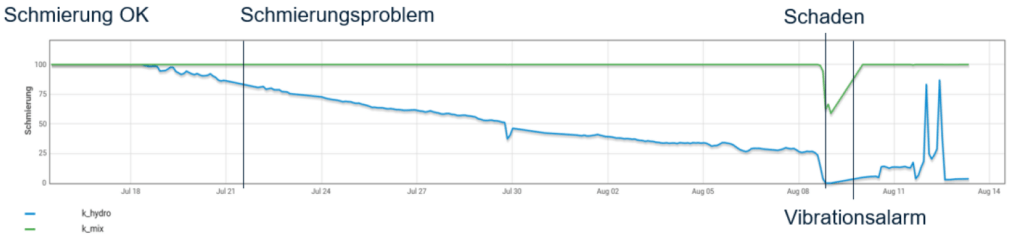
- HCP Sense indicated an emerging lubrication problem 3 weeks before the damage occurred.
- A simple measure such as relubrication or a slight adjustment of operating parameters would have completely prevented the damage.
- Since provoking a total failure was the objective of this ‘run-to-failure’ test, no intervention was made.
- HCP Sense detected the failure 24 hours earlier than the vibration-based system. Final damage: severe bearing failure with cage breakage.
- Thus, HCP Sense achieved the earliest warning in the entire benchmark test compared to conventional vibration sensors with integrated spectral analysis — by a significant margin.
Added Value for Hitachi Energy
- Longest early warning time compared to other evaluated systems relying exclusively on vibration-based analysis.
- Mitigation of severe failure modes enabled through timely and targeted maintenance interventions.
- Direct monitoring of the underlying physical root cause (lubrication state).
- Low system integration complexity combined with high operational robustness.
- Particularly suitable for deployment in critical infrastructure environments and OEM integration scenarios.
Conclusion
This case study clearly demonstrates that true early warning is only possible when the root cause of damage is detected—not just the damage itself.
HCP Sense identifies critical lubrication conditions that conventional condition monitoring technologies based solely on vibration analysis are unable to detect. This enables a new level of operational safety for operators of critical infrastructure and high-performance pump systems.