The Customer
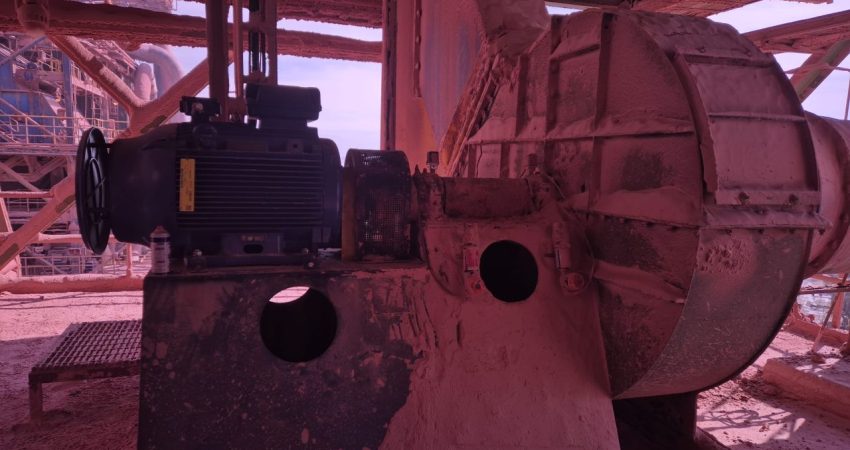
Israel Chemicals is an international company operating in the raw materials and specialty chemicals industry. Its facilities rely on industrial fans running continuously under conditions involving contamination and the high ambient temperatures typical of the site.
The fans are essential to the production process. Their bearings are therefore continuously supplied with grease via an automatic lubrication system.
Initial Situation
The fan bearings were re-lubricated several times a day with a predefined amount of grease. Both the quantity and the lubrication intervals were based on experience and the concern of applying too little grease – not on the actual condition of the bearings.
Because the lubrication system operates automatically, the grease was never supplied too late. It was supplied too often.
The consequences are often silently accepted by operators: the grease is churned inside the bearing, bearing temperatures rise, and the grease ages faster than necessary. Contamination and high ambient temperatures further intensify this effect. At the same time, the system consumes significantly more grease than necessary. A fixed lubrication interval is always a compromise. It must account for the worst-case operating conditions and is therefore unsuitable for most operating hours – because it has no information about contamination, load changes or temperature.
Objective
The automatic lubrication system was to remain in place – but no longer operate based on experience alone. Together with Israel Chemicals, the following objectives were defined:
- Measure the lubrication condition directly inside the bearing, continuously during operation.
- Control the existing automatic lubrication system based on these measurements, rather than at fixed intervals.
- Supply only as much grease as the bearing actually needs – thereby reducing grease consumption.
- Extend the service life of the grease inside the bearing and consequently increase bearing service life.
- Ensure a reliable supply at all times: Using less grease must never mean that the bearing runs dry.
Solution: HCP Sense Controls Automatic Lubrication
HCP Sense uses electrical impedance measurements at the bearing to monitor the condition of the lubricant film, including the effects of contamination. The measured values indicate whether the bearing surfaces are safely separated by a lubricant film or approaching a critical condition.
The key lies in how this data is used: it directly controls the automatic lubrication system. Grease is supplied when the measured condition requires it and withheld as long as the bearing is adequately lubricated. A fixed lubrication interval becomes a demand-based control system.
Results
- From several times a day to approximately once a week. Condition-based lubrication requires only a fraction of the previous re-lubrication cycles, while maintaining stable operation.
- Significantly less grease inside the bearing. The bearing no longer has to work against excess grease. Churning losses and the associated heat generation are reduced.
- Longer grease service life. Grease that is not constantly churned and overheated ages more slowly. Each grease filling lasts longer.
- Longer bearing service life. Lower temperatures and lubricant in better condition extend bearing operating life.
- Reduced grease consumption. This also means less replenishment, less logistics effort and less disposal of used grease.
Benefits for the Operator
- Significantly less grease — instead of several times a day, re-lubrication is required approximately once a week.
- Lower operating costs through reduced grease consumption, less replenishment and less waste grease.
- Longer bearing service life, as neither the grease nor the bearings are subjected to unnecessary stress.
- The system continues to operate as usual — the automatic lubrication system remains in place, but benefits from a better basis for decision-making.
- Reliable lubrication supply: The reduction is based on measurements directly from the bearing, not on a shortened lubrication schedule.
- Greater operational safety: If a problem occurs with re-lubrication, for example due to an empty grease reservoir or a malfunction, a warning is issued before bearing damage can occur.
Conclusion
At Israel Chemicals, excessive lubrication was taking place – several times a day simply because no one knew the actual condition of the bearings. By measuring directly inside the bearing, this has been reduced to approximately one re-lubrication per week, while maintaining stable operation.
That is the key point: knowing the lubrication condition eliminates the need for guesswork. It saves grease, keeps bearings cooler and extends the service life of both the lubricant and the bearings.